

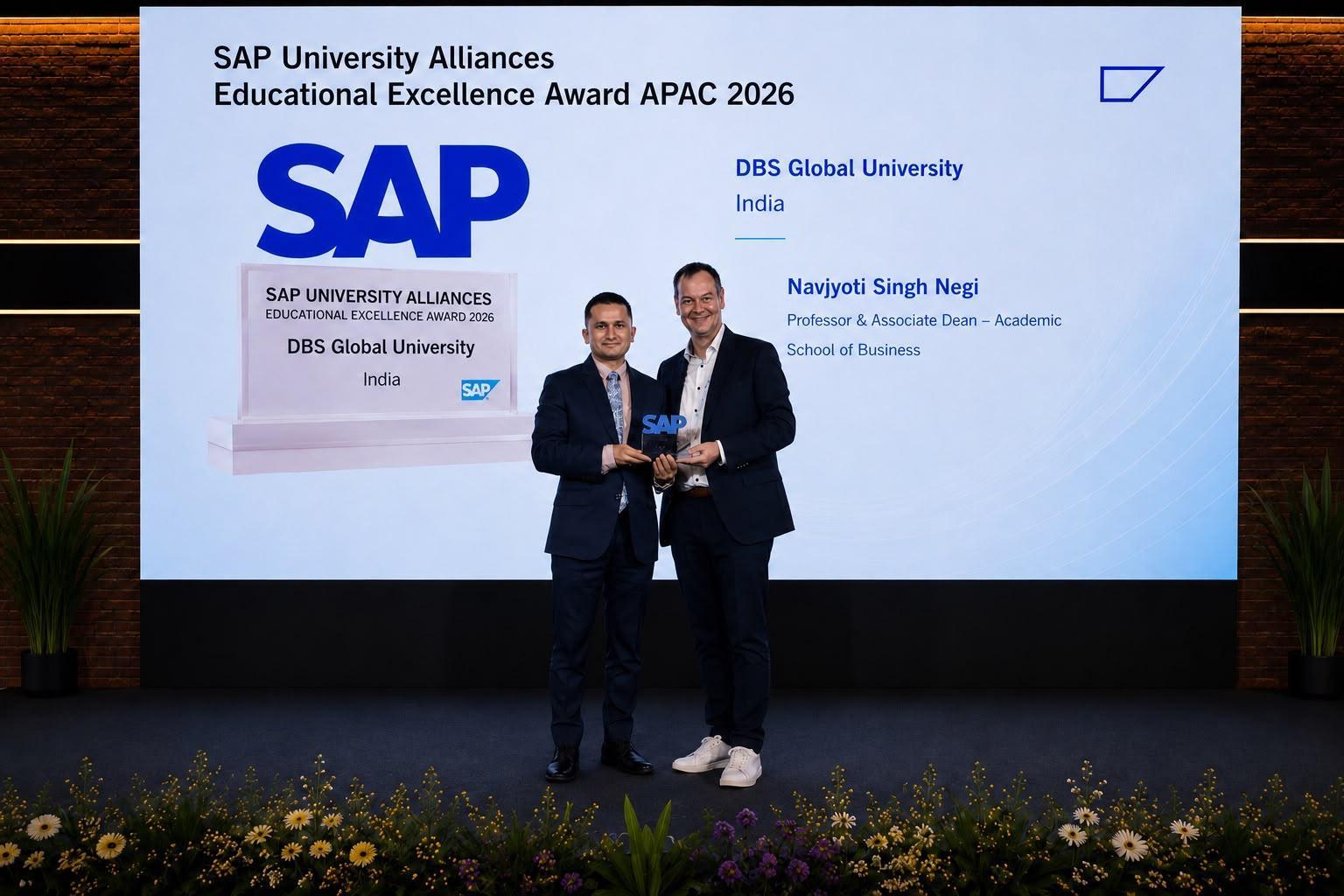
Asia-Pacific recognition reflects DBS Global University’s vision of global recognition, quality education and emerging technology backed by years of enterprise learning, experienced faculty and SAP-focused career outcomes for its engineering and Business students
Dehradun: DBS Global University (DGU), Dehradun, has been honoured with the SAP University Alliances Educational Excellence Award APAC 2026 (Asia-Pacific a region that includes India, Indonesia, Australia, New Zealand, Japan, South Korea, China, Singapore, Malaysia, Thailand, Vietnam and the Philippines) at the SAP Academic Community Conference APAC 2026 in Indonesia, placing the University among the leading institutions across one of the world’s most competitive higher-education regions.
The award was accepted on behalf of the University by Dr Navjyoti Singh Negi, Associate Dean, before educators, academic leaders and technology experts from across the region.
The recognition gives Asia-Pacific validation to a direction the University set for itself 18 years ago: “To be globally recognised for delivering quality education and embracing emerging technologies & innovation, while empowering future leaders to shape a sustainable and progressive world.”
That vision is increasingly taking shape through an academic ecosystem built around emerging technologies, enterprise education, artificial intelligence, industry engagement and globally relevant learning.
What it means for a B.Tech & Business student
For engineering and Business students, the recognition translates into something concrete.
SAP software runs the operational core of a very large share of the world’s enterprises – finance, supply chain, manufacturing, human capital, customer experience and business intelligence. Every one of those systems has to be implemented, configured, extended, integrated and maintained, and that work is done by engineers. The roles that follow are technical and distinct from generic IT hiring: ABAP and RAP developers, SAP BTP and Fiori developers, integration engineers, HANA data and analytics engineers, functional-technical consultants, and the newest category agentic AI and automation roles, where AI copilots and autonomous agents are being embedded into enterprise workflows.
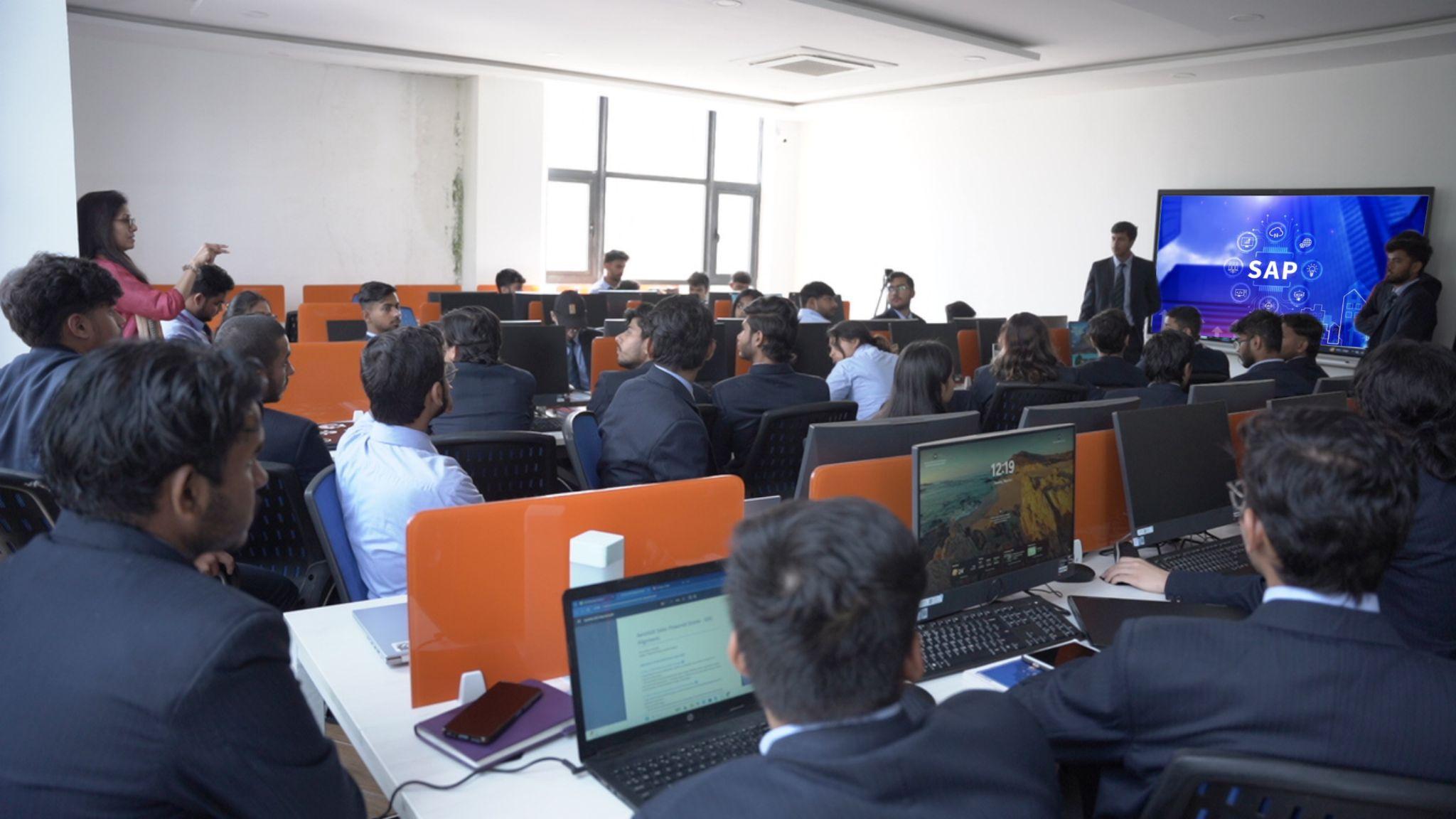
The supply-demand gap in these roles exists for a simple reason. A computer science graduate can teach themselves a web framework over a weekend. They cannot teach themselves how a procure-to-pay cycle works, or what breaks in a production planning run, without access to a live enterprise system and faculty who have worked on one. At DGU, B.Tech students get both-live SAP environments, ERPsim business simulations developed at HEC Montréal, a dedicated course on SAP Build Code, SAP Build Apps and Copilot Joule delivered by a certified SAP Build Pro Code trainer, and analytics exposure through the University’s alliance with SAS, United States.
The result is a graduate who can write code and also understands what the code is for a combination recruiters consistently find hard to hire.
From learning about technology to learning through technology
For decades, technology was largely treated as a specialised academic subject. The rapid growth of artificial intelligence, analytics, cloud platforms and enterprise systems is fundamentally changing that approach.
Universities increasingly need to prepare engineering students to solve real organisational problems, business students to understand data, and management students to work with enterprise systems.
At DBS Global University, this shift is reflected in an academic approach that seeks to integrate technology and AI across the learning ecosystem rather than treating them as standalone additions to the curriculum.
A defining part of this ecosystem is the University’s engagement with SAP University Alliances, a membership held since 2009, connecting enterprise technology with academic learning and exposing students to digital business environments relevant across global industries.
SAP technologies support critical functions within modern organisations, including finance, supply chains, manufacturing, human resources, customer experience and business intelligence. Exposure to enterprise ecosystems therefore enables students to understand how technology connects different organisational functions and supports business decision-making.
An important part of this academic approach is the involvement of experienced faculty members, industry professionals and domain experts in delivering specialised and technology-oriented education.
In enterprise education, learning a technology platform is only one part of the process. Students also need to understand business functions, organisational workflows, data-driven decision-making and the professional environments in which these technologies are applied. DGU’s academic ecosystem has therefore evolved around connecting conceptual learning with professional application.
Complementing the University’s enterprise learning ecosystem is its alliance with SAS, United States, a global leader in analytics and artificial intelligence. Through analytics, predictive modelling, business intelligence and AI-driven decision-making, students gain exposure to another critical dimension of the modern digital enterprise.
Together, enterprise technology, analytics and AI create a learning environment designed not simply around knowing technology, but understanding how technology operates within modern organisations.
When recruiters seek specialised SAP talent
One of the strongest indicators of an academic ecosystem’s relevance is sustained industry engagement.
The University’s engagement with SAP and enterprise education is not a recent addition to its academic framework. For more than 17 years, DGU has been developing students for SAP and enterprise-oriented professional profiles. This sustained focus has translated into specialised career opportunities, with organisations including BP, Deloitte, PwC, KPMG, Infosys, EY, Tech Mahindra and HCLTech recruiting DGU students for SAP-related roles and profiles.
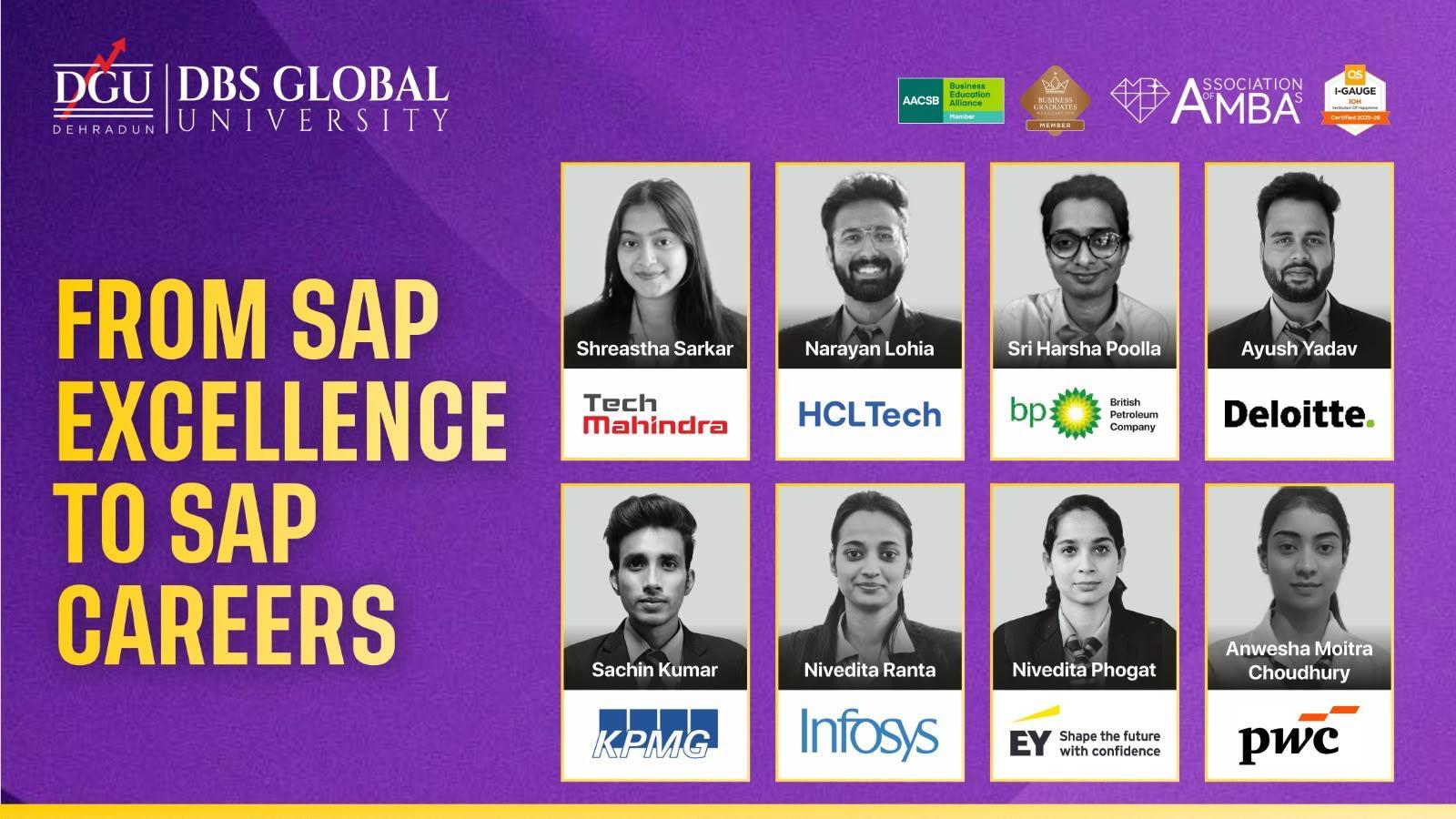
The continuity of such recruitment over more than a decade is particularly important. It demonstrates that enterprise education at the University is not being approached as a short-term response to a technology trend. Instead, it has developed into an established academic and career-oriented ecosystem supported by faculty expertise, professional exposure and evolving industry requirements.
For students, this creates a stronger connection between what they learn in classrooms and the roles emerging within consulting, technology and global enterprises.
As employers increasingly evaluate a graduate’s ability to analyse problems, understand digital platforms and adapt to complex business environments, specialised enterprise exposure is becoming an important professional differentiator.
A global vision rooted in student outcomes
DBS Global University’s vision places global recognition, quality education, emerging technologies and innovation at the centre of its institutional development. The SAP University Alliances Educational Excellence Award APAC 2026 closely aligns with this direction.
Global education today is no longer defined only by international travel or overseas partnerships. It is increasingly about giving students access to globally relevant knowledge, technologies, academic practices and professional environments.
DGU’s approach is focused on building an interconnected learning ecosystem where academic education is strengthened through technology platforms, practical projects, industry engagement and international opportunities.
The objective is to prepare students not only for their first professional role, but for careers that may evolve across technologies, industries and geographical boundaries.
This philosophy is particularly relevant at a time when many of the roles today’s students may eventually enter are being transformed by artificial intelligence and automation.
The challenge for universities is no longer simply to teach what industry needs today. It is to develop graduates capable of learning, adapting and leading through continuous change.
Why enterprise education matters for India
India has one of the world’s largest and youngest talent pools. Its ability to translate this demographic advantage into economic leadership will depend significantly on the quality and relevance of higher education.
The gap between classroom knowledge and workplace expectations has long been a concern for employers and academic institutions. Bridging this divide requires a different model of education, one where universities, technology organisations and industry partners contribute to a connected learning ecosystem.
Enterprise platforms play an important role in this transition because they expose students to the systems and processes through which modern organisations operate.
Business decisions today are increasingly driven by data. Supply chains are digitally connected. Human resource systems are becoming technology-enabled. Artificial intelligence is influencing decision-making across functions.
Students therefore need more than theoretical understanding. They need to understand how technology, business processes and human decision-making interact in real organisational environments.
The SAP Academic Community Conference APAC 2026 reflected this changing educational landscape, bringing together conversations around artificial intelligence, sustainability, enterprise innovation and future-focused teaching.
For DGU, recognition at such a platform aligns with its broader ambition to create education that is globally connected, technologically relevant and directly linked with student outcomes.
Building a university for the future of work
The university of the future is unlikely to be defined solely by lecture halls, textbooks or examinations. Its relevance will increasingly be measured by the ecosystems it creates around its students.
Can students engage with emerging technologies? Can they work on real-world problems? Can they understand global business environments? Can they connect data and technology with organisational decision-making? And, most importantly, can they continue learning when the technologies they studied at university inevitably evolve?
These questions are shaping the academic direction of institutions worldwide.
At DBS Global University, the focus on AI integration, enterprise technologies, analytics, experiential learning, industry engagement and international academic exposure reflects an effort to address these changing expectations through a connected educational model.
The University’s international academic initiatives and global learning opportunities further support an environment where students can develop cross-cultural understanding alongside professional and technological skills.
An Indian university with global ambitions
The SAP University Alliances Educational Excellence Award APAC 2026 is an institutional achievement for DBS Global University, but its wider significance lies in what it represents.
Indian universities are increasingly becoming active participants in global conversations around the future of education. They are adopting emerging technologies, engaging with international academic networks and building closer relationships with industries that will employ the next generation of graduates.
For DBS Global University, the recognition in Indonesia strengthens a direction already embedded in its institutional vision: to build a globally recognised university where quality education, emerging technology and innovation prepare future leaders for a rapidly changing world.
Importantly, DGU’s experience demonstrates that global recognition becomes more meaningful when connected with sustained academic delivery and tangible student outcomes.
As higher education enters an era shaped by artificial intelligence, enterprise transformation and borderless collaboration, universities will need to move faster, collaborate deeper and think beyond conventional academic models.
DGU’s recognition at the Asia-Pacific level signals its intent to be part of that transformation.
Because in the future of higher education, global relevance will not be defined simply by where a university is located. It will be defined by how effectively it connects its students to the technologies, industries and opportunities shaping the world.
