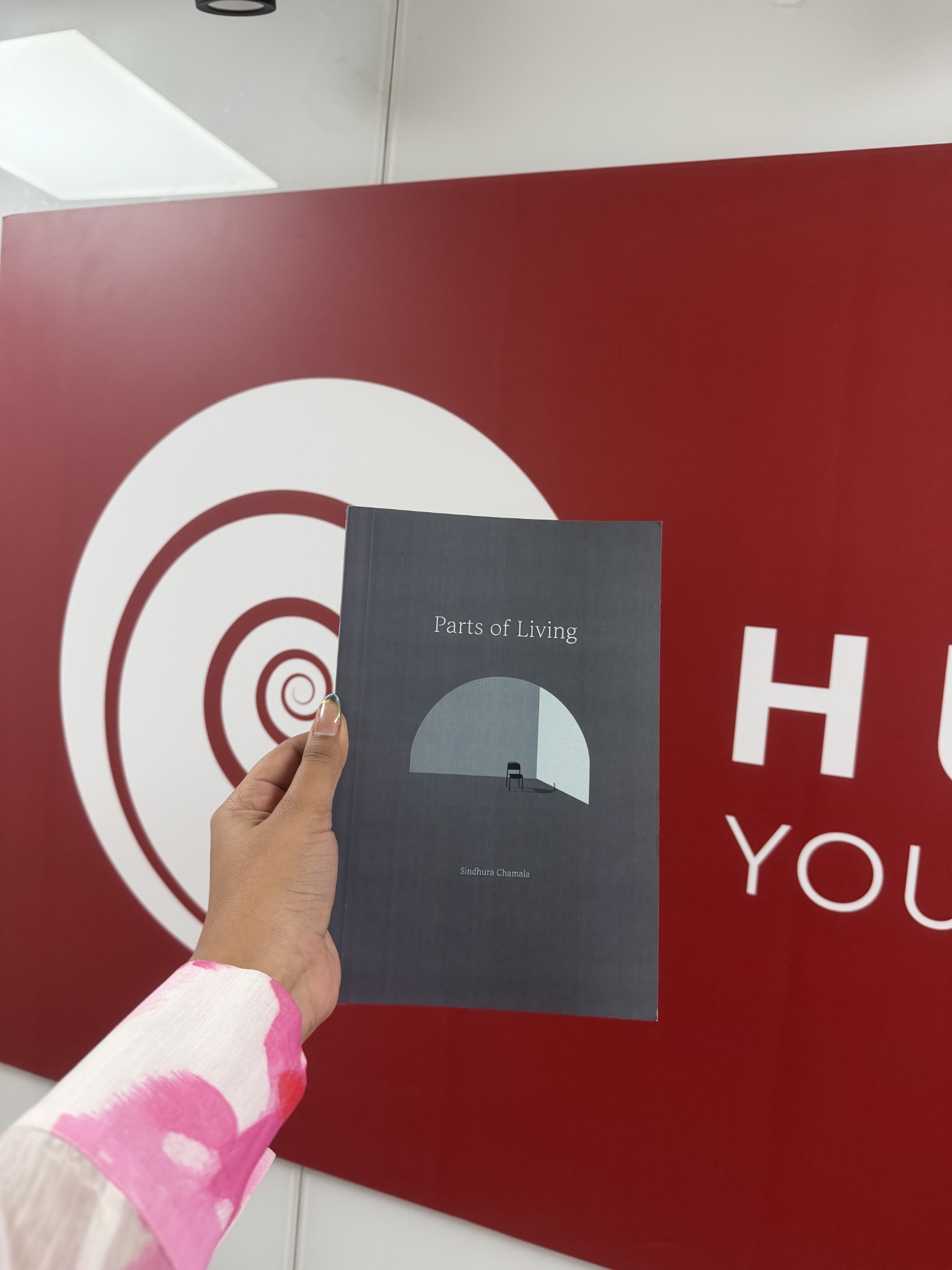
Sindhura Chamala spends her weekdays writing code as a software engineer in Bangalore. Her debut novel, Parts of Living, is slower and more watchful than a conventional plot-driven story, and it is unwilling to hand readers a tidy answer. At the Frankfurt Book Fair 2026, Hubhawks represented the novel, bringing a quieter, deeply interior work of fiction into an international publishing setting.
The novel centres on Meera, a fifty-year-old woman who lives alone, holds down a steady job and has built a life that, from the outside, appears entirely in order. Beneath that routine, however, something in her has been quietly wearing down for years. When a medical diagnosis disturbs the structure she has relied on to get through her days, Meera begins confronting a thought she has carried silently for a long time: whether a life stripped of desire necessarily needs to continue. The novel does not offer Meera, or the reader, an easy way out of that question.
Told across three weeks, Parts of Living follows Meera through ordinary days, half-formed reconnections, old relationships she revisits and strangers caught in their own versions of struggle. There is no single crisis driving the narrative forward. Instead, Chamala pays attention to something harder to dramatise: the quiet resistance to effort, to hope and to the simple act of continuing. The question running beneath Meera’s days is what it takes for someone to choose to stay when nothing promises them a reason to.
The novel’s restraint is central to its effect. Rather than forcing its protagonist towards a dramatic turning point or offering a neat resolution to the questions she confronts, the story stays close to the rhythms of ordinary life. Small encounters and tentative reconnections carry weight because they unfold against Meera’s larger uncertainty. The result is a narrative that asks readers to sit with discomfort rather than move quickly past it.
That approach also seems to reflect something of Chamala herself. Originally from Nalgonda, she describes her life away from work in similarly unhurried terms: reading, writing and chasing stories, often with a cup of tea nearby. Her writing is drawn to the interior lives of people and the quiet weight of ordinary experience. In Parts of Living, that attention becomes a patient examination of a woman whose outwardly stable life no longer offers the certainty it once did.
The novel’s central question is difficult because it resists a universal answer. Meera’s experience cannot be reduced to a single lesson or a simple argument about hope. Instead, the story considers how people live through periods when familiar sources of meaning have weakened, and how the possibility of connection may appear in forms that are small, uncertain or incomplete.
Through its representation of Parts of Living at Frankfurt 2026, Hubhawks brought a debut novel that asks for patience and rewards close attention. Among books that move through dramatic events and clear resolutions, Chamala’s story makes space for a quieter kind of narrative one willing to remain with a difficult question long enough for its emotional complexity to emerge. It is a novel about the fragile work of continuing, and about what it can mean to stay when the reasons are not immediately clear.